

You’ve invested in solar panels, but did you know you could also get paid for the electricity you don’t use?
Through the Smart Export Guarantee (SEG), energy suppliers pay homeowners for surplus electricity exported back to the National Grid.
The application process is actually quite straightforward once you know what’s required. In this guide, we’ll walk you through everything you need to know so you can start earning from your solar system.
What is the Smart Export Guarantee (SEG)?
The Smart Export Guarantee (SEG) is a government-backed scheme that requires many UK electricity suppliers to pay homeowners for exporting renewable electricity to the grid.
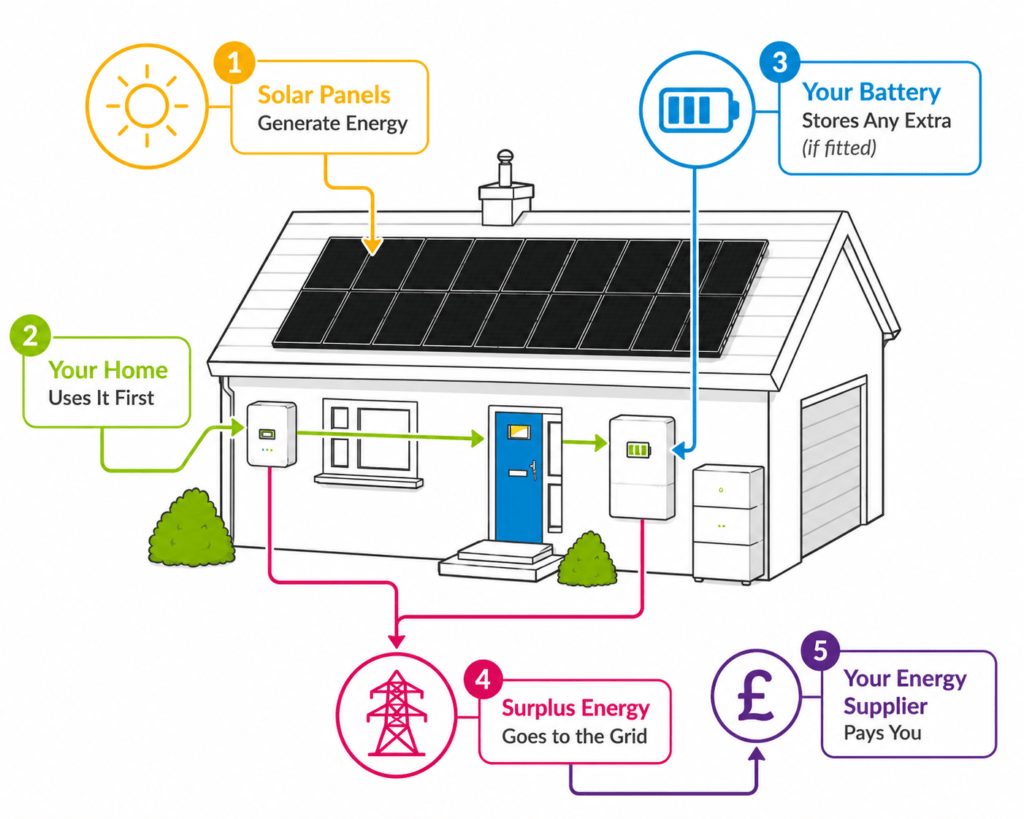
Whenever your solar panels produce more electricity than your home is using, the excess energy is automatically exported.
Rather than letting that energy go to waste, your supplier pays you for every unit (kWh) exported.
Step 1 - Make Sure You're Eligible
Before you can apply for SEG payments, you’ll need:
- Solar PV installed by an MCS-certified installer
- An MCS Certificate
- A smart meter capable of recording exported electricity
If your solar system was installed by Menai Heating, you’ll receive your MCS certificate as part of your handover pack.
Step 2 - Compare SEG Tariffs
Not all suppliers pay the same export rate.
Some pay:
- Fixed rates
- Variable rates
- Time-of-use tariffs
Choosing the right supplier can make a significant difference to how much you earn over the year.
Even if another company supplies your electricity, you may still be able to use a different company for your SEG payments.
Popular suppliers include:
- Octopus Energy
- British Gas
- EDF
- E.ON Next
- Ovo Energy
Step 3 - Gather Your Documents
Most suppliers will ask for:
MCS Certificate – This proves your solar installation meets government standards.
Smart Meter Details – Your export meter allows suppliers to measure exactly how much electricity you send back to the grid.
Proof of Identity – Usually driving licence, passport
Proof of Address – Utility bill, bank statement
Bank Details – This is where SEG payments will be sent
Step 4 - Apply Online
Once you’ve chosen a supplier:
- Visit their SEG webpage.
- Complete the application form.
- Upload your documents.
- Submit your application.
Most applications only take around 10 – 20 minutes.
Step 5 - Start Getting Pain
Once approved, your supplier will begin tracking the electricity your home exports. Payments are usually made monthly or Quarterly depending on your supplier.
Approval typically takes between 2 and 8 weeks.
Frequently Asked Questions
Do I have to use my electricity supplier?
Do I have to use my electricity supplier?
No. Some suppliers allow anyone to join their SEG tariff, while others require you to be an electricity customer.
Can I change suppliers later?
Can I change suppliers later?
Yes.
You’re free to switch to another SEG provider if they offer a better export rate.
Will a battery affect my payments?
Will a battery affect my payments?
Yes.
A battery stores more of your electricity to use later, meaning you’ll export less to the grid.
While this usually reduces your SEG payments, it often increases your overall savings because you’re buying less electricity from your supplier.
Is SEG worth it?
Is SEG worth it?
Absolutely.
Although SEG payments alone won’t usually pay for a solar system, they’re a great bonus alongside the savings you make by generating your own electricity.